
Embroidered patches and other branded patches: when to use them
Short answer
Embroidered patches are logos stitched onto a backing fabric, then sewn or heat-sealed onto a product. Woven, PVC, silicone and PU leather patches work the same way with different finishes. A patch suits caps, bags and jackets, and fabrics you can’t embroider directly. For a very large design, choose a print; on heat-sensitive fabric, sew the patch on rather than heat-sealing it.
Technique
- Best for
- Caps, jackets, bags, waterproof shells
- Types
- Embroidered, woven, PVC, silicone, PU leather
- Attached by
- Sewing, heat-seal or adhesive backing
- Limits
- Large designs, heat-sensitive fabrics
How branded patches work.
Choosing the type
The logo and the product decide it. Embroidered patches give raised texture, woven patches hold fine detail, PVC and silicone are soft and rubbery (PVC is waterproof), and PU leather gives a tonal, tailored badge.
Making the patch
The patch is made separately from the product: stitched or woven onto a backing, moulded in PVC or silicone, or cut from PU and engraved or debossed. Its edge is then finished, often with a stitched border.
Choosing the backing
A plain back for sewing, a heat-seal adhesive for pressing on, or a pressure-sensitive backing for hard items.
Attaching it
Sewn patches are stitched around the edge. Heat-seal patches are pressed on with set time, temperature and pressure, so nothing pierces the fabric.
Checking the placement
Finished pieces are checked for position and a secure edge.
Where embroidered patches work best.
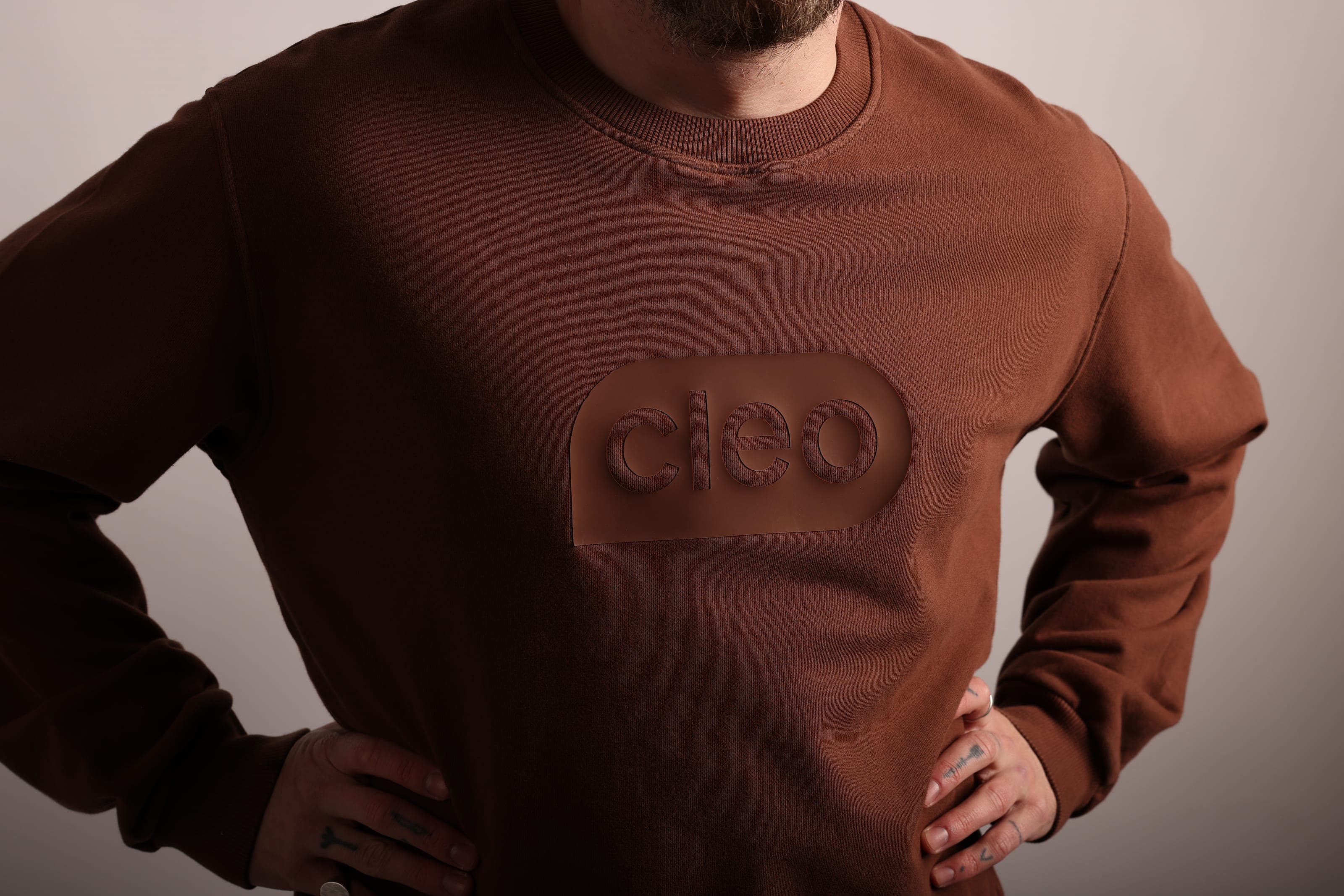
Cleo · Silicone patch Sweatshirts and knitwear
A tonal patch gives a quiet, premium mark on the chest. Cleo’s brown sweatshirt carries a silicone patch in the same colour as the fabric, so the logo reads as texture rather than print.
Caps and beanies
A patch gives the front panel a neat, structured badge. One cap maker offers embroidered, woven, silicone and faux leather patches for this.
Branded capsWaterproof jackets
A heat-sealed patch brands the shell without punching needle holes through it, which direct embroidery can’t avoid.
Embroidered jacketsBags and backpacks
A sewn patch or PU badge suits heavier bags, where a stitched badge looks at home.
Branded tote bagsOne badge across a collection
The same patch can go on caps, jackets and bags, so every piece carries an identical mark.
Where it has limits.
Very large designs. A patch is a badge, not a back print. For a big graphic, choose screen printing.
See Screen printing
Heat-sensitive fabrics. One patch maker doesn’t recommend heat-applied patches on some nylons, silk, leather, wool or fleece. Sew the patch on instead, or embroider directly.
Lightweight, stretchy fabric. A stiff patch can pull or sit awkwardly on a thin T-shirt. A print usually looks better there.
Fine detail on embroidered patches. Thread has thickness, so small text closes up. One maker asks for letters at least 4 mm high. A woven patch holds finer detail.
Photographic artwork. Thread and moulded patches use solid colours. A printed patch with an embroidered outline is one way to show shading.
Patch or direct embroidery?
Direct embroidery stitches the logo straight into the garment. A patch is made first, then attached. Both give a stitched look, so the choice comes down to the product and the design.
- Waterproof or technical shell
- Patch. A heat-sealed patch brands it without piercing the waterproof layer.
- Small text or fine lines
- Woven patch. It holds detail that direct stitching can’t.
- Heavy cap, polo or sweatshirt
- Either. Direct embroidery is the simpler finish; a patch adds a raised, badge-like look.
- The same mark on mixed products
- Patch. Make one design and attach it to caps, bags and jackets alike.
- Soft, flexible feel
- Direct embroidery. It’s stitched into the garment itself, with no separate badge or edge.
Weighing up direct stitching?Logo embroidery
Artwork that works.
- Send a vector file
- AI, EPS, SVG or PDF with outlined text.
- Keep colours few
- One patch maker allows up to 6 thread colours on embroidered and woven patches, and up to 4 on PVC.
- Size the text
- On embroidered patches, one maker asks for letters at least 4 mm high. Woven patches can go down to about 2 mm.
- Leave a margin
- If the patch is sewn on, one maker suggests a 3 mm channel around the design for the stitching.
- Pick the shape and edge
- Round, rectangular or cut to your logo’s outline, with or without a stitched border.
These are typical industry figures, not fixed limits. We confirm the specification for every order.
What affects the cost.
- Patch type
- Embroidered, woven, PVC, silicone and PU each have their own set-up and making process.
- Size and colours
- Larger patches and more colours take longer to make.
- Shape and border
- A custom outline or stitched border adds a step.
- Attachment
- Sewing each patch on takes longer than heat-sealing.
- Quantity
- Set-up is shared across the run, so the cost per patch falls as the order grows.
In our catalogue, patches mostly come as PU badges and labels, engraved PU leather badges and printed patches with an embroidered outline, and Cleo’s sweatshirt carries a silicone patch. For an embroidered, woven or PVC patch, tell us the product and we’ll confirm what’s possible.
Need help getting the artwork ready?Design & artwork
Care and durability.
A well-attached patch lasts well. How long depends on the type and how it’s fixed.
Care for patched pieces
- Wash cold and inside out.
- Use a mild detergent.
- Don’t iron directly over the patch.
Patch types compared.
Embroidered patches. Thread stitched onto a backing, for a raised, textured badge. The classic choice for bold logos.
Woven patches. Thinner threads woven tightly, for a flat, smooth patch that holds small text and fine lines.
PVC and silicone patches. Moulded in soft, rubbery material. One maker’s PVC patches come flat or domed, are waterproof and suit outerwear, outdoor gear and caps.
PU leather badges. Cut from PU and engraved or debossed for a tonal, tailored mark. PVC-based faux leather shouldn’t be laser engraved, because it gives off toxic gas.
Printed patches with an embroidered outline. A printed centre for full colour and shading, with a stitched border so it still reads as a patch.
Worth knowing
One patch maker rates its embroidered patches for at least 50 domestic washes, and its PVC patches for up to 25. For pieces that will be washed hard, a sewn edge adds security.
Source: Transfer Express, “Embroidered patches”, accessed 6 October 2026. · Source: Transfer Express, “PVC patches”, accessed 6 October 2026.
Managed
Planning patches for caps, jackets or bags? Tell us who they’re for.
Planning something bespoke? Explore Studio
Questions about embroidered patches.
Woven patches vs embroidered patches: which is better?
It depends on the logo. Embroidered patches have raised, textured stitching that suits bold shapes. Woven patches use thinner thread, woven tightly, so they’re flatter and hold small text and fine lines. If your logo has a strapline or thin lines, choose woven.
Can you put leather patches on caps?
Yes. Faux leather patches with a debossed logo are a standard option at one cap maker, alongside embroidered, woven and silicone patches. A leather-look patch suits structured caps, where it sits flat on the front panel.
Should I use a patch or embroider directly?
Embroider directly for a soft, simple finish on caps, polos and sweatshirts. Choose a patch for waterproof shells, for logos with fine detail (as a woven patch), or when the same badge needs to go on several different products.

Want us to handle it?
Tell us who you are sending to and what you have in mind. We’ll help connect the products, the packaging and the delivery plan.
Or call 0800 118 4047 or email hello@goswag.com.