
Screen printing: what it is, how it works and when to use it
Short answer
Screen printing pushes ink through a fine mesh stencil onto fabric, one colour at a time. It’s the classic choice for bold logos and large designs on T-shirts, hoodies and tote bags, and it gets better value as the quantity grows. For photographs, short runs with many colours or hard, curved items, another method usually suits them better.
Technique
- Best for
- T-shirts, hoodies, sweatshirts, totes
- Limits
- Photos, many colours on short runs, hard goods
- Artwork
- Vector file, one Pantone per colour
- Care
- Wash inside out, don’t iron the print
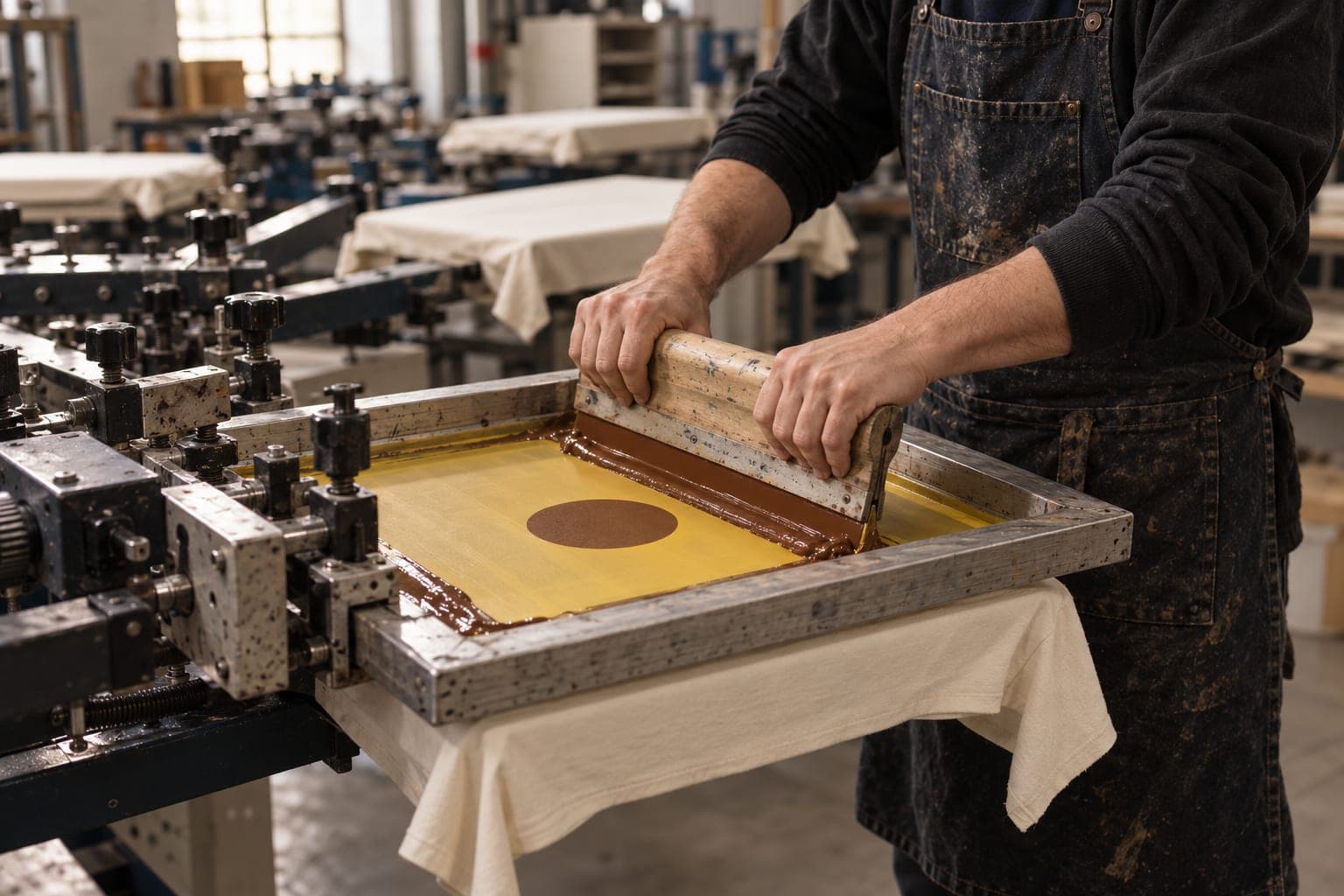
How screen printing works.
Separating the artwork
Your design is split into one layer for each ink colour. A two-colour logo becomes two layers, and each layer becomes its own screen.
Making the screens
A fine mesh stretched on a frame is coated with a light-sensitive emulsion and exposed through a film of your artwork. Where light hits, the emulsion hardens. The rest washes out, leaving an open stencil in the shape of your design.
Setting up the press
The screens are fitted to the press and lined up with each other, so every colour lands in exactly the right place on the garment. This lining up is called registration.
Printing
Ink is flooded across the screen and a squeegee pulls it through the open mesh onto the fabric. Each colour is printed in turn, one screen after another.
Curing
The print passes through a dryer that heats the whole ink layer until it cures. Properly cured ink bonds to the fabric and survives washing. Under-cured ink can crack and wash away.
Where screen printing works best.
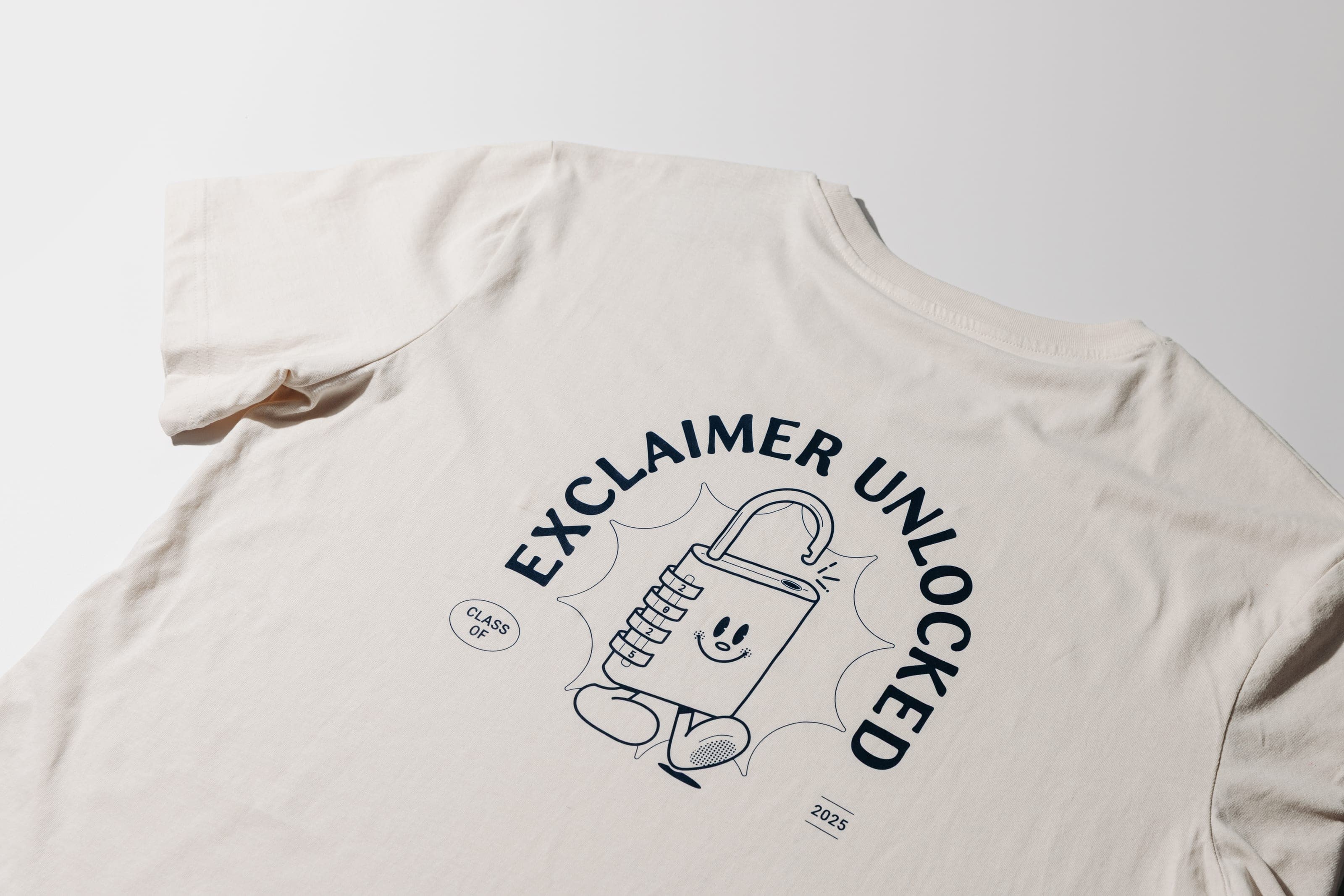
Exclaimer · Screen-printed T-shirt T-shirts
A flat, smooth surface takes a crisp print, from a small chest logo to a full front design. It’s the natural choice for event and team tees.
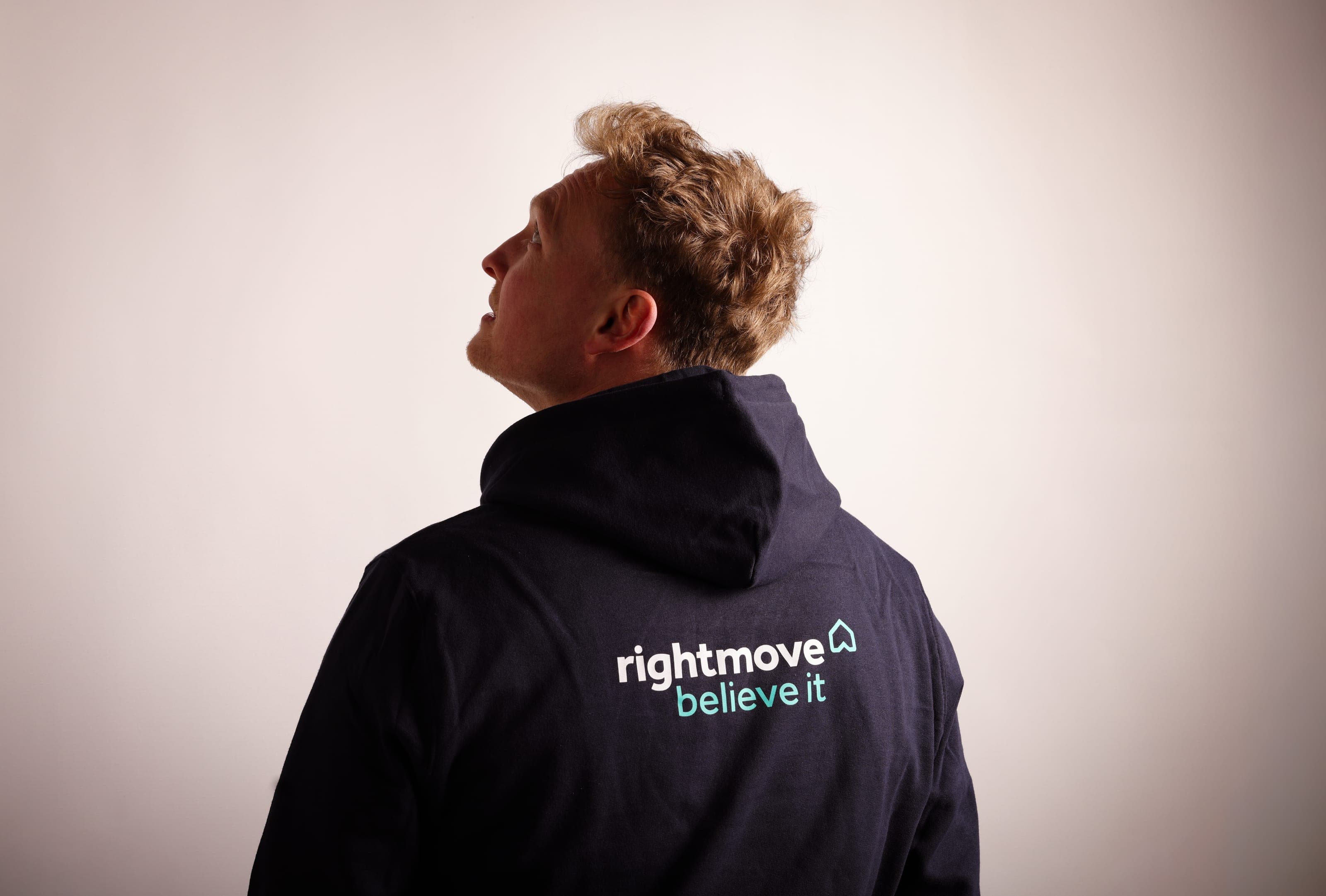
Rightmove · Hoodie with a screen-printed back Hoodies and sweatshirts
Large back prints and slogans are where print beats thread, because a big embroidered area adds weight and stiffness. Rightmove’s navy hoodies carry a full back print.
Branded hoodies
Tote bags and canvas
Flat cotton and canvas take ink well, so a one or two-colour logo on a tote is a strong, simple combination.
Branded tote bagsDark garments
Plastisol, the most common garment ink, is opaque, so light colours stay bright on navy, black and other dark fabrics.
Where it has limits.
Photographs and gradients. Each screen prints one solid colour. Shading can be faked with tiny halftone dots, but a photograph is better suited to a full-colour digital print.
Many colours on a short run. Every extra colour means another screen to make and line up. On a small order, a six-colour design costs far more to set up than a one-colour version. Simplify the artwork, or ask about a digital method.
A premium, textured finish. Print sits flat on the fabric. For a small logo on a cap, polo or heavy sweatshirt, embroidery often looks more considered.
Waterproof nylon and polyester. Standard ink won’t stick to waterproof nylon without a bonding agent, and dyes in some polyester can bleed into the ink and tint it. Both need specialist inks and a test print first.
Hard and curved items. Garment screen printing is made for fabric. Pens, mugs and bottles are usually pad printed or engraved instead.
Artwork that works.
- Send a vector file
- AI, EPS, SVG or PDF with the text converted to outlines, so every edge stays sharp at any size.
- Name each colour
- Give a Pantone reference for every colour. Each one becomes a separate screen, so the count matters.
- Keep lines printable
- One transfer maker asks for printed lines at least 0.3 mm (0.012 in) thick and gaps at least 1 mm (0.04 in) wide. Finer than that, lines break up or fill in.
- Plan for halftones
- Gradients and shadows are printed as dots. Flat areas of solid colour print cleanest.
- Say what the garment colour is
- Light inks on a dark garment often need a white base layer printed first, which counts as an extra colour.
These are typical industry figures, not fixed limits. We confirm the specification for every order.
What affects the cost.
- Number of colours
- The biggest driver. One screen for each colour, each made and lined up before the run.
- Print positions
- A chest print and a back print are two separate set-ups.
- Quantity
- Set-up is shared across the run, so the cost per piece falls as the order grows.
- Garment colour
- A white base layer under light inks on dark fabric adds a screen.
- Specialist inks
- Bonding agents for nylon and low-bleed inks for polyester add to the job.
Need help getting the artwork ready?Design & artwork
Care and durability.
A properly cured print stands up to plenty of washing. A little care keeps it sharp.
Care for screen-printed pieces
- Turn the garment inside out before washing.
- Don’t iron directly over the print.
- Avoid dry cleaning.
Variations worth knowing.
Water-based and discharge inks. Alternatives to plastisol. The water in them can wear away a standard stencil, so they need screens made to resist water.
Puff ink. Ink mixed with a puff additive. The dryer’s heat makes it swell, so the design stands slightly proud of the fabric. It needs bold shapes: one transfer maker asks for gaps of at least 2.5 mm (0.1 in) in puff designs.
Metallic and glitter inks. Special-effect inks printed through coarser mesh, for a finish flat colour can’t give.
Screen-printed transfers. The design is screen printed onto a transfer, then heat-pressed onto the product. In our catalogue it’s offered mostly on bags, and on some caps.
Worth knowing
Plastisol, the most popular ink for printing garments, doesn’t dry at room temperature: it has to reach about 149–166°C (300–330°F) through the whole ink layer to cure.
Source: Lawson Screen & Digital Products, “General information about screen printing plastisol inks”, accessed 6 October 2026.
Managed
Planning printed tees or hoodies for your team? Tell us who they’re for.
Planning something bespoke? Explore Studio
Questions about screen printing.
What is silk screen printing?
It’s the same thing as screen printing. The mesh was once made of silk, which is where the name comes from. Today the mesh is a synthetic fabric, but the method is unchanged: ink is pushed through a stencil on a stretched mesh, one colour at a time.
How many colours can a screen print have?
As many as the press has stations, but each colour needs its own screen, lined up with the others. That’s why one or two-colour logos are the most economical, and why designs with many colours suit larger runs, where the extra set-up is shared across more pieces.
Is screen printing or DTG better for small runs?
For a one- or two-colour logo, screen printing can still make sense on a small run. The screens take the same work whether you print 20 shirts or 2,000, so every extra colour adds noticeably to the price per piece. For a handful of full-colour or photographic pieces, DTG prints straight from the file with no screens, so it usually suits better.

Want us to handle it?
Tell us who you are sending to and what you have in mind. We’ll help connect the products, the packaging and the delivery plan.
Or call 0800 118 4047 or email hello@goswag.com.