
Pad printing: how it works and when to use it
Short answer
Pad printing transfers ink from an etched plate onto a product with a soft silicone pad, which wraps around curves a flat screen can’t reach. It’s the usual choice for small logos on pens, mugs, bottles and tech accessories. For large designs, photographs, gradients or full wraps around a bottle, a digital print usually suits them better.
Technique
- Best for
- Pens, mugs, bottles, tech accessories
- Limits
- Large areas, photos, gradients, full wraps
- Artwork
- Vector file, one Pantone per colour
- Colours
- Spot colours, one plate each
How pad printing works.
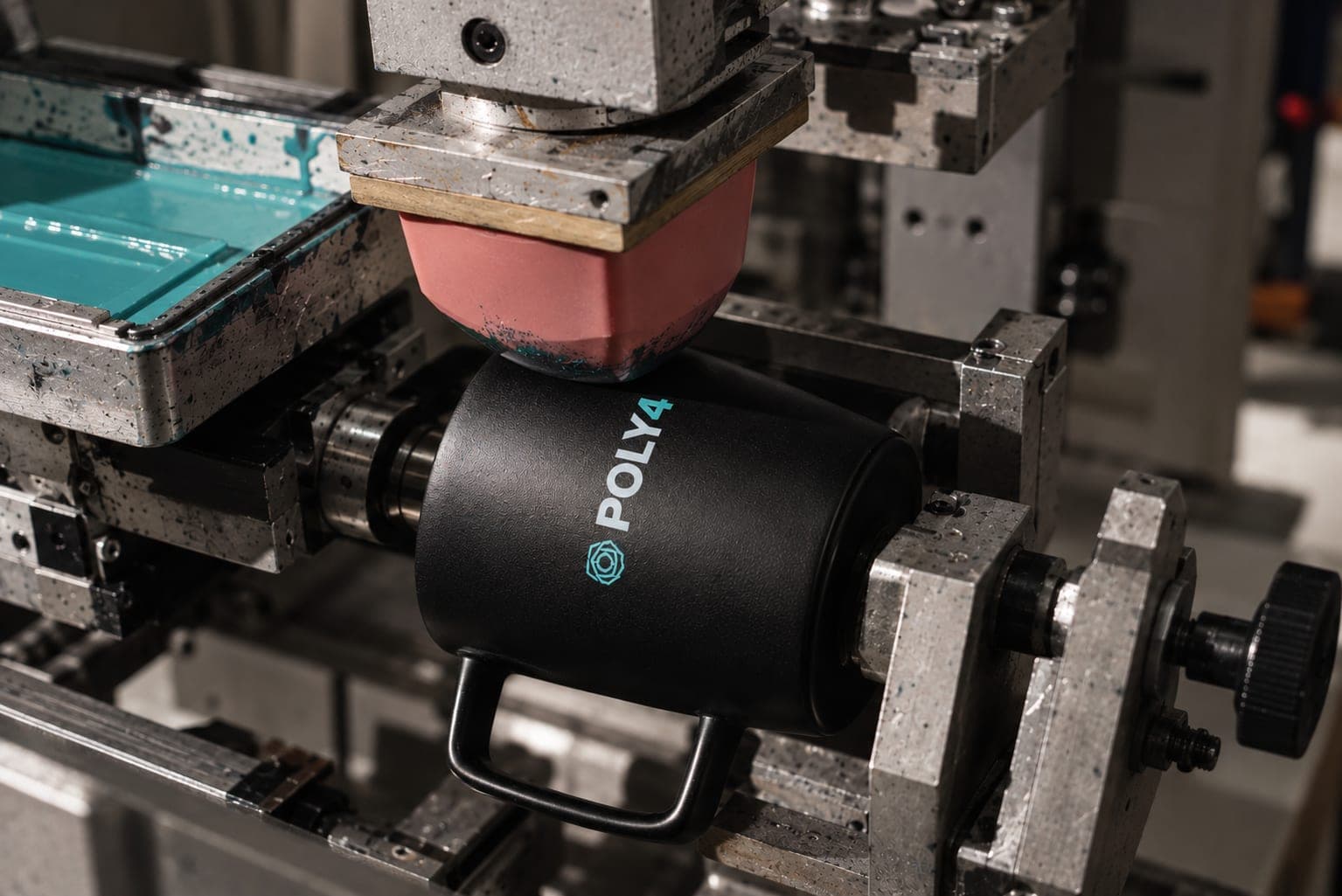
Making the plate
Your logo is etched into a flat plate, called a cliché, as a very shallow recess. Plates are made with a light-sensitive coating or cut by laser.
Inking the plate
A sealed cup of ink slides across the plate and back. It leaves ink only in the etched logo and wipes the rest of the plate clean.
Picking up the image
A soft silicone pad presses down onto the plate. As it squashes, it lifts the thin film of ink out of the etch, now in the shape of your logo.
Printing the product
The pad moves across and presses onto the product. Because it’s soft, it rolls around the curve of a pen barrel or a mug and lays the ink down cleanly.
Repeating for each colour
Each colour has its own plate area and its own print, lined up with the last. Then the ink dries or is cured, sometimes with a hardener for extra resistance.
Where pad printing works best.
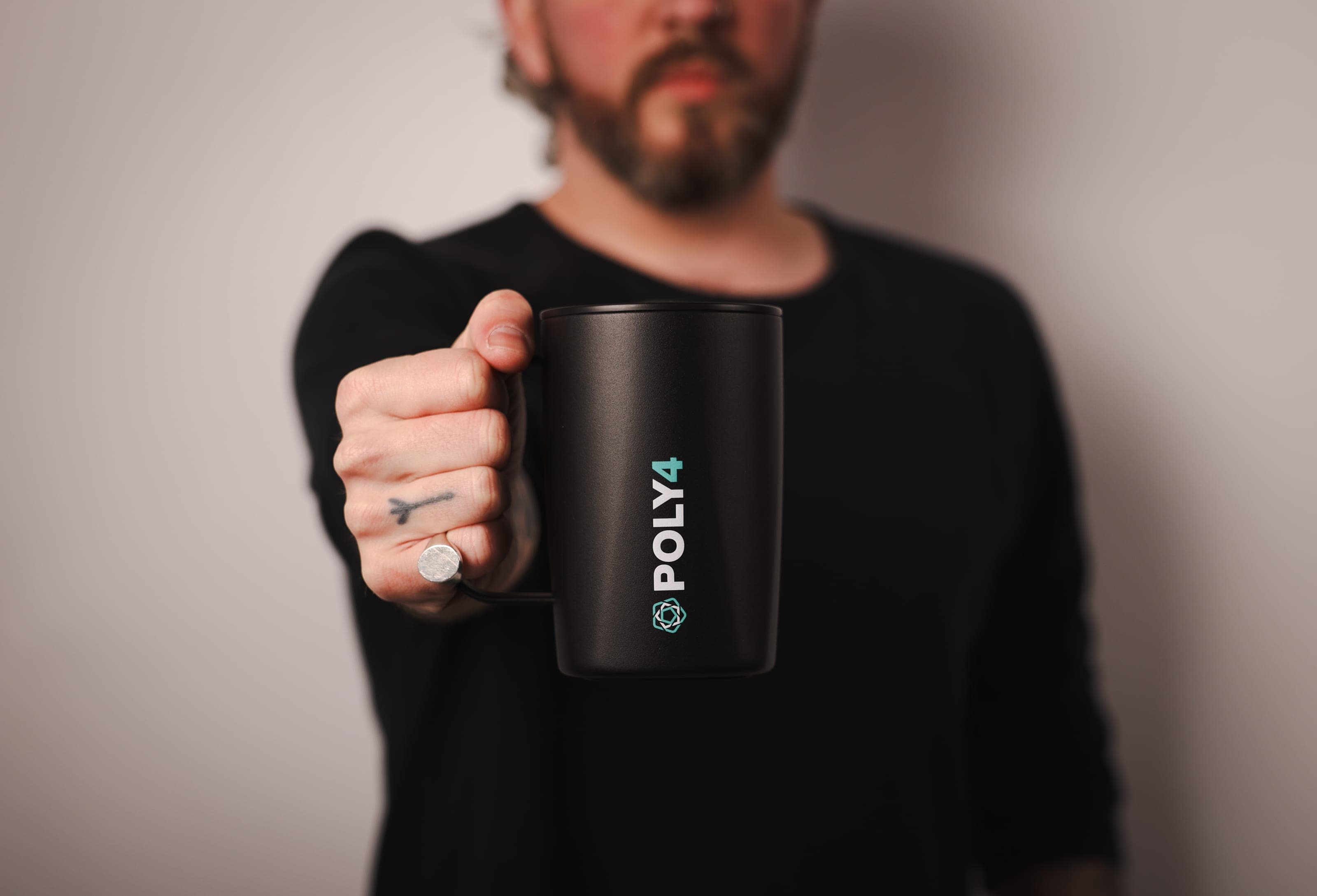
POLY4 · Pad-printed mug Mugs and drinkware
A logo on the side of a mug, cup or bottle, where the surface curves away. POLY4’s matte black mug carries its teal logo pad printed onto the curve.
Branded mugs
Pens
Pens are one of the most common pad-printed products. The pad reaches round the barrel or clip, where a small one or two-colour logo sits neatly.
Branded pensTech and small hard items
Power banks, USB sticks, earbud cases and key rings, where the logo is small and the surface isn’t flat.
Plastic, metal and glass
Inks are made for each material, so the same method works across a mixed set of hard items.
Where it has limits.
Large print areas. The image size is limited by the ink cup. One equipment maker’s pad printers take designs from 80 mm across on its tabletop models to 190 mm on its largest. For bigger areas, screen or digital printing does better.
Photographs and gradients. Pad printing lays down solid spot colours. Full-colour photos and smooth fades suit a digital print method.
Full wraps around a bottle. A design that runs all the way round is better printed on a rotary digital printer, which can print the whole way round in one go.
Many colours. Each colour needs its own plate and its own pass, lined up with the others, so keep designs simple.
Fabric. Pad printing is for hard surfaces. On clothing and bags, choose screen printing or embroidery.
Artwork that works.
- Send a vector file
- AI, EPS or PDF, with the text converted to outlines.
- Name each colour
- A Pantone reference for every colour. Each one is a separate plate and print.
- Keep lines thick enough
- One maker asks for printed lines at least 0.3 mm (1 pt) thick, and light lines or gaps knocked out of a printed area at least 0.4 mm (1.5 pt).
- Keep text readable
- The same maker asks for text at least 3 mm high.
- Skip effects
- The same maker can’t pad print gradients or transparency effects such as drop shadows. On a black product, it prints a white layer first.
These are typical industry figures, not fixed limits. We confirm the specification for every order.
What affects the cost.
- Number of colours
- Each colour needs its own plate and its own print.
- Print positions
- A logo on each side of a mug, or on a pen’s barrel and clip, is two prints.
- White base layer
- Bright colours on a dark product need white printed first.
- Quantity
- The plate is made once, so its cost is shared across the run.
- Product shape
- Awkward shapes need a custom holder to keep each piece steady under the pad.
Need help getting the artwork ready?Design & artwork
Care and durability.
A pad print is a thin layer of ink on the surface, so how long it lasts depends on the ink and how it’s treated.
Care for pad-printed items
- Check the product’s own care label, especially whether it’s dishwasher safe.
- Hand wash printed mugs and bottles where you can.
- Avoid abrasive scourers on the printed area.
Ink makers formulate each ink for its material, and a hardener can make a print more resistant to wear. One maker gives dishwasher resistance on glass as an example of what a hardener helps with.
Worth knowing
On bottles, one pad-printing equipment maker suggests pad printing for designs that cover up to about 25% of the circumference, and a rotary digital printer for full wraps, gradients and photographic images.
Source: Inkcups, “Bottle printing”, accessed 6 October 2026.
Managed
Putting your logo on pens, mugs or bottles? Tell us what’s in the set.
Planning something bespoke? Explore Studio
Questions about pad printing.
What is pad printing?
Pad printing is an indirect printing method for hard, shaped objects. Ink sits in a logo etched into a flat plate, a soft silicone pad picks it up, and the pad presses it onto the product. It’s also called tampo printing or tampography.
Can you pad print on a curved mug?
Yes. The soft pad wraps around the curve, which is exactly what it’s for. It suits a logo on one or both sides of a mug. If you want a design that runs all the way round, a digital wrap print is usually the better choice.
Is pad printing durable on pens?
It’s one of the most common ways to brand pens, and the inks are made for plastic and metal. A hardener can be added where a print needs extra resistance to wear. For a permanent, ink-free mark on a metal pen, laser engraving is the alternative to ask about.
Pad printing or UV printing?
Pad printing suits curved and uneven surfaces and small designs in a few solid colours. UV digital printing suits flat or gently curved surfaces and full-colour artwork with gradients, and it needs little set-up. The shape of the item and the artwork usually decide it.

Want us to handle it?
Tell us who you are sending to and what you have in mind. We’ll help connect the products, the packaging and the delivery plan.
Or call 0800 118 4047 or email hello@goswag.com.