
The EU €3 parcel duty and the end of the €150 de minimis
Short answer
The EU de minimis, the customs duty relief for consignments worth €150 or less, ended on 1 July 2026. Until 1 July 2028, low-value goods sold online to consumers in the EU pay a flat €3 per item category, however they travel. Other imports pay the normal duty for each product, and import VAT generally applies on top.
At a glance
Rules last verified 9 October 2026
- In force from
- 1 July 2026
- Flat duty
- €3 per item category, on online sales
- Runs until
- 1 July 2028, unless extended
- The law
- Council Regulation (EU) 2026/382
What to do.
- Count the categories, not the items. Group identical products and list each kind of item once on the invoice, with its commodity code and value.
- Value every gift realistically. Use the market value for anything you aren’t selling, and keep the invoice with the goods.
- Decide who settles the charges before you send. If you ship DDP, the sender pays duty and VAT before delivery. If you ship DAP, the person receiving it is asked to pay.
- Keep each consignment under control. Know whether a box is a sale or a gift and whether it crosses the €150 line, because both change the duty.
- Check the rule before every peak send. The flat rate is temporary and reviewed monthly. Re-read the Commission’s guidance before a large send.
Sending gifts into the EU? We handle the customs and duties.Start your project
The rule, in plain English.
Until 30 June 2026, goods worth €150 or less could enter the EU without customs duty. Council Regulation (EU) 2026/382 deleted that relief from 1 July 2026. Since then, low value alone no longer exempts goods from customs duty.Source 1
For the smallest consignments, the regulation sets a temporary flat rate: €3 per item in a consignment worth €150 or less that’s sold online to a consumer in the EU (a distance sale). Since 1 July 2026 that applies however the parcel travels, by post or courier, and whether or not the seller uses IOSS, the EU’s import VAT scheme for online sellers. It runs until 1 July 2028.Source 1Source 10Source 11
Imports that aren’t sold online to a consumer, such as business-to-business shipments, pay the normal rate in the EU’s Common Customs Tariff for each product. Import VAT is generally charged on top.Source 1Source 6Source 10
Which parcels pay the €3.
The flat rate applies only when all of these are true. Slide the value to see which side of the line a consignment falls.
Checklist
When the €3 flat rate applies
Up to €150 per consignment and sold online to a consumer in the EU: €3 per item category, however it travels. Over €150, or not an online sale: the normal duty for each product. Import VAT applies either way.€150 or less and sold online to a consumer in the EU: €3 per item category. Otherwise the normal tariff. Import VAT on top. Source 1
Rules last verified 9 October 2026
- Worth €150 or less in total. The test is the intrinsic value of the whole consignment, not of each item.Source 1The parcel
- Sold online to a consumer in the EU. The €3 is for distance sales: goods sold to a consumer and sent from outside the EU, by post or courier, with or without IOSS. Other imports pay the normal tariff.Source 10Source 11The seller
- Counted once per item category. The charge follows tariff classification, not quantity, so identical items count once.Source 2Source 3Customs
- No preferential origin claimed. Goods that benefit from a preferential trade agreement are excluded, as long as the VAT wasn’t collected through IOSS and they’re declared on a full (H1) import declaration.Source 3The importer
- Import VAT is still due. The €3 is a customs duty. Goods imported into the EU are generally subject to VAT as well.Source 6The importer
Information, not advice. Rules last verified 9 October 2026.
A €2 handling fee is coming.
On 21 September 2026 the Commission set a Union handling fee of €2 per item on goods sold online to consumers in the EU (distance sales), at any value. It’s a fee for customs checks, not a duty. It applies ten days after publication in the Official Journal, which the Commission expects by 1 November 2026. Ask your carrier how it treats company gifts.Source 4Source 9Source 11
What it means for branded gifts and swag.
- A mixed order counts each kind of item. A T-shirt, a notebook and a bottle sit in different tariff classifications, so an online order of all three worth €150 or less pays €3 three times: €9 in duty, before import VAT.Source 1Source 2Source 10
- Ten of the same item still count once. An online order of identical caps is one item category, so the flat duty is €3 however many caps are inside, as long as the order stays within €150.Source 2Source 3
- Company gifts: check before you send. The €3 targets online sales to consumers, and a company gift isn’t sold to the person receiving it. The Commission’s guidance doesn’t cover gift shipments, so confirm the duty and handling with your carrier or customs broker before you send.Source 10Source 11
- The €150 line is for the whole consignment. A box of several gifts for one person is valued as one consignment. Over €150, the flat rate is off the table and every item pays its normal rate.Source 1
Edge cases worth knowing.
- Gifts between private individuals. The separate relief for occasional gifts sent by one private individual to another is unchanged by this regulation. Company gifts don’t qualify for it: German customs says deliveries from or to companies cannot be recognised as gift shipments, even if they’re free of charge.Source 1Source 5
Common mistakes.
- Assuming low value means no duty. The €150 relief is gone. A €20 gift entering the EU no longer escapes duty for being low value: it pays the flat €3 per item category or its normal tariff rate.Source 1
- Reading €3 as a charge per parcel. It’s charged per item category inside the parcel. A varied pack pays more than a parcel of one product.Source 2
- Marking a company gift as a gift. Gift relief is for private individuals. A label that says “gift” doesn’t change how customs treats a parcel from a company.Source 5
- Leaving the charges to the recipient. When the sender doesn’t take on import clearance (DAP), the person receiving the parcel is the one asked to deal with it.Source 8
How Go Swag helps.
We send international orders DDP: we handle customs and duties, so recipients have nothing to pay on arrival. Customs, duties and taxes are worked out up front, in your quote. And wherever we can, swag for EU recipients is made, held and sent inside the EU, so those sends don’t cross a customs border at all.
From our work
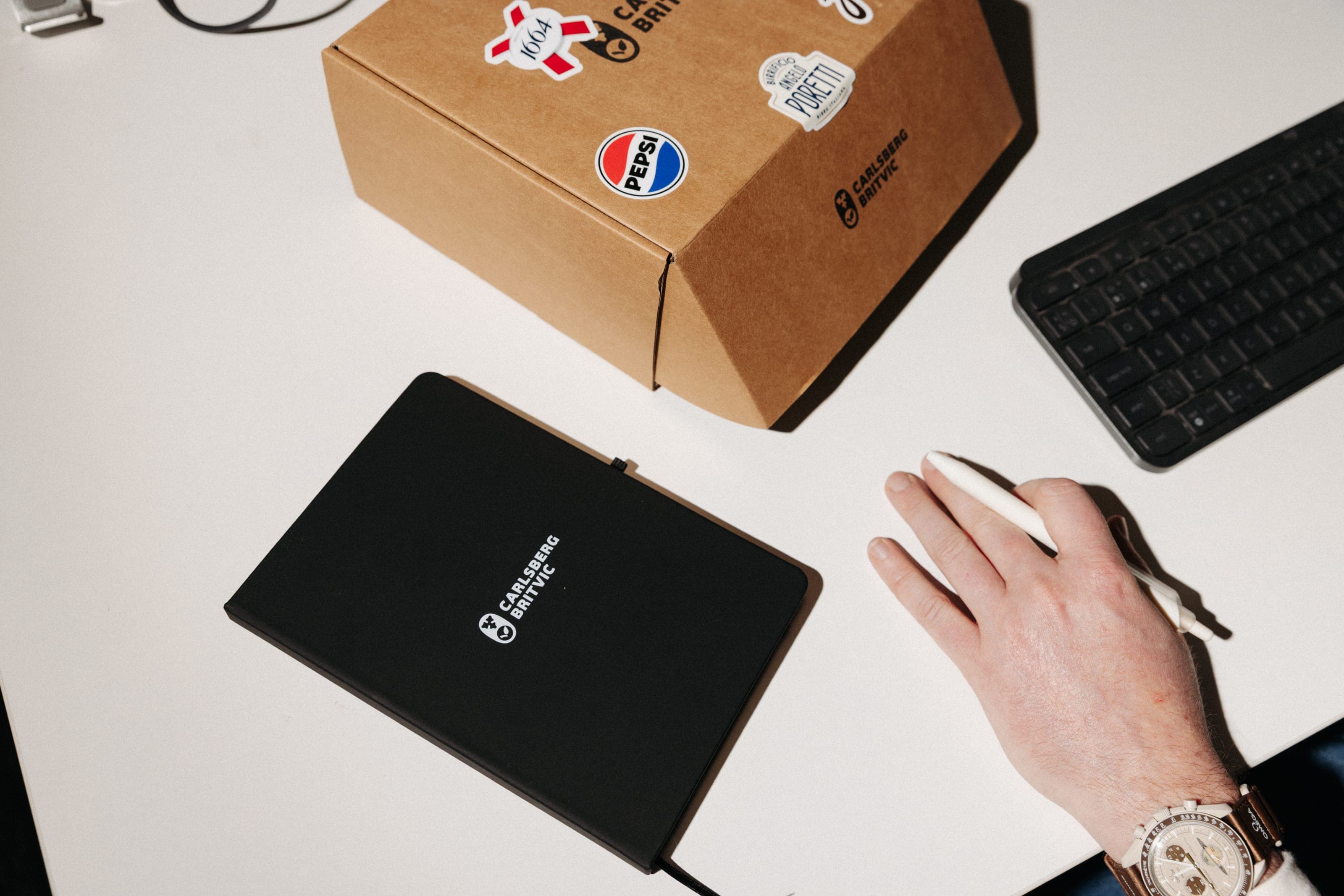
Each kind of product in a pack like this is its own item category, which is how the €3 is counted on an online sale worth €150 or less.
Managed
Sending packs into the EU? Tell us where they’re going and we’ll work out the duty up front.
Worth knowing
The €3 could widen. From 1 October 2026 the Commission checks every month whether trade is shifting to avoid it, and if it is, it may propose applying the flat rate to every consignment worth €150 or less.
Source: EUR-Lex, Official Journal of the European Union, “Council Regulation (EU) 2026/382 of 11 February 2026 amending Regulation (EC) No 1186/2009 as regards the elimination of the threshold-based customs duty relief”, accessed 9 October 2026. Source 1
Questions about the EU de minimis.
What is the EU de minimis?
It was the customs duty relief for consignments with an intrinsic value of €150 or less. Council Regulation (EU) 2026/382 removed it from 1 July 2026, so low-value goods entering the EU now owe duty. The temporary €3 flat rate replaces it for low-value goods sold online to consumers in the EU.
Is the EU €150 duty exemption removed?
Yes. Since 1 July 2026 there is no customs duty relief for consignments worth €150 or less. What changed is how much they pay: €3 per item category on goods sold online to consumers in the EU, until 1 July 2028, and the normal tariff rate on other imports.
Does the €3 duty apply per item or per parcel?
Per item category, based on tariff classification rather than quantity. Five T-shirts in one parcel pay €3. Three T-shirts and a watch pay €6, because they are two different classifications.
Does the €3 duty replace import VAT?
No. It’s a customs duty. Import VAT is charged as well, at the rate of the country where the goods enter, so a low-value gift into the EU usually carries both.
Will my employee in the EU have to pay it?
Only if nobody pays the charges before delivery. On a DAP send the courier asks the recipient to settle duty and VAT. On a DDP send the sender settles them first, and the gift arrives with nothing to pay.
This guide is general information, not legal or customs advice. The rules are temporary and under monthly review, so check the current position with your carrier or a customs adviser before you send.
Sources
11 sources
- 01Council Regulation (EU) 2026/382 of 11 February 2026 amending Regulation (EC) No 1186/2009 as regards the elimination of the threshold-based customs duty relief (opens in a new tab) · EUR-Lex, Official Journal of the European Union, accessed 9 October 2026.Back to reference 1
- 02Ensuring fairness and safety: €3 customs duty for low-value parcels (opens in a new tab) · European Commission, accessed 9 October 2026.Back to reference 2
- 03Guidance and legal text on temporary flat fee on low-value imports which will apply until 1 July 2028 (opens in a new tab) · European Commission, Taxation and Customs Union, accessed 9 October 2026.Back to reference 3
- 04EU Customs Reform (opens in a new tab) · European Commission, Taxation and Customs Union, accessed 9 October 2026.Back to reference 4
- 05Gifts (opens in a new tab) · Zoll (German customs), accessed 9 October 2026.Back to reference 5
- 06Import process: shipments from a non-EU country (opens in a new tab) · Zoll (German customs), accessed 9 October 2026.Back to reference 6
- 07Export goods from the UK: step by step (opens in a new tab) · GOV.UK, accessed 9 October 2026.Back to reference 7
- 08DAP & DDP Incoterms® 2020 explained: Key differences (opens in a new tab) · ICC Academy (International Chamber of Commerce), accessed 9 October 2026.Back to reference 8
- 09Commission Delegated Regulation of 21.9.2026 supplementing Regulation (EU) 2026/2108 by establishing the amount of the Union handling fee (C(2026) 6694 final) (opens in a new tab) · European Commission, accessed 9 October 2026.Back to reference 9
- 10Commission Delegated Regulation (EU) 2026/1022 amending Delegated Regulation (EU) 2015/2446 as regards definitions, customs declarations and data elements related to the temporary EUR 3 customs duty on distance sales of imported goods in a consignment with an intrinsic value not exceeding EUR 150 (opens in a new tab) · EUR-Lex, Official Journal of the European Union, accessed 9 October 2026.Back to reference 10
- 11The temporary EUR 3 customs duty and the Union handling fee (guidance) (opens in a new tab) · European Commission, Taxation and Customs Union, accessed 9 October 2026.Back to reference 11

Want us to handle it?
Tell us who you are sending to and what you have in mind. We’ll help connect the products, the packaging and the delivery plan.
Or call 0800 118 4047 or email hello@goswag.com.